The Chromatic Resolution of the Local Group
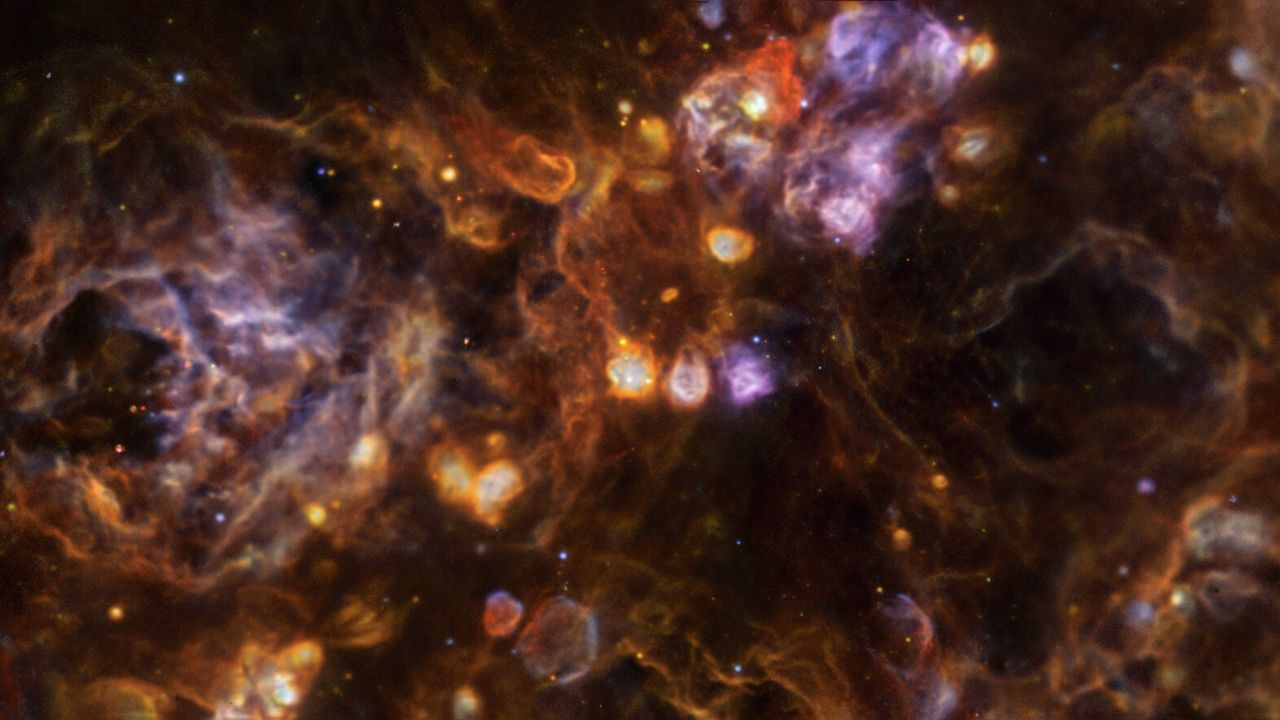
The release of the latest imaging of the Triangulum Galaxy (M33) on March 23, 2026, represents a significant milestone in multi-spectral astrophysical reconnaissance. This neighboring spiral galaxy, situated approximately 2.7 million light-years away, has been captured in a psychedelic array of colors that are far from mere aesthetic choices. These hues represent a complex synthesis of data across the electromagnetic spectrum, providing a high-fidelity map of the galaxy's structural dynamics.
The current capability to resolve individual stellar nurseries with this degree of clarity highlights the rapid maturation of orbital sensor arrays. Unlike previous iterations of galactic imaging, the 2026 data set integrates infrared, ultraviolet, and X-ray telemetry into a unified visual framework. This allows analysts to observe the interplay between cold gas reservoirs and high-energy radiation with unprecedented precision.
Strategically, the Triangulum Galaxy serves as a critical benchmark for our own Milky Way’s evolution. As a member of the Local Group, its relative proximity allows for the testing of cosmological models without the observational interference inherent in imaging our own galactic disc from within. The focus remains on the present reality: we are now entering an era where galactic-scale mapping is no longer a speculative endeavor but a foundational industrial requirement for the next generation of space exploration platforms.
Multispectral Synthesis and Molecular Mapping
The 'psychedelic' appearance of M33 is a direct result of false-color mapping used to distinguish various physical processes occurring simultaneously within the galactic arms. The vibrant magentas and electric blues signify intense star-forming regions, often referred to as H II regions, where ionized hydrogen is reacting to the thermal output of newborn massive stars. These areas are the engines of galactic growth, and their distribution provides vital clues about the rotational kinematics of the Triangulum system.
Deep-layer analysis of the interstellar medium (ISM) reveals a complex web of cold dust and molecular clouds, rendered in deep oranges and reds. This distribution is essential for understanding the lifecycle of matter in the cosmos. By isolating these wavelengths, researchers can track the transition of atomic gas into molecular structures, which eventually collapse under gravity to form new solar systems.
Furthermore, the 2026 imagery underscores the importance of data-processing pipelines in modern astronomy. The raw telemetry from deep-space arrays requires sophisticated algorithms to reconcile different focal lengths and exposure times into a coherent image. This process is not merely scientific; it is a demonstration of sovereign technological prowess in the field of high-performance computing and image recognition. The ability to render the invisible visible is the hallmark of current strategic intelligence in the space sector.
The Geopolitics of High-Fidelity Astrophysical Assets
Beyond the scientific utility, the publication of such imagery carries significant weight in the arena of space diplomacy and industrial competition. The infrastructure required to produce these images—ranging from cryogenic cooling systems for infrared sensors to ground-based deep-space networks—represents a multi-billion dollar investment. In the present landscape, the control and dissemination of such high-value data are key components of soft power.
Commercial entities are increasingly involved in the secondary analysis of these data sets. The precision of the 2026 Triangulum map provides a gold standard for calibrating commercial remote sensing equipment. As private corporations expand their presence in low Earth orbit and beyond, the reliance on publicly funded foundational science remains a critical nexus. The synergy between government-led discovery and private-sector application is the primary driver of the current space economy.
Moreover, the global reception of these 'psychedelic' images serves as a barometer for public engagement with space initiatives. In an era where funding is frequently scrutinized, the ability to translate complex astrophysical data into compelling, high-impact visual narratives is essential. These images are not just tools for researchers; they are strategic assets used to justify the continued expansion of the global orbital infrastructure and to inspire the next generation of the aerospace workforce.
Strategic Integration of Celestial Intelligence
The definitive takeaway from the March 23, 2026, observation of M33 is the transition from observational astronomy to integrated celestial intelligence. We are no longer simply looking at stars; we are cataloging the resources and dynamics of the local universe with the same rigor applied to terrestrial geointelligence. The Triangulum Galaxy provides a laboratory for studying the fundamental laws of physics at a scale that remains unattainable in any terrestrial facility.
The industrialization of this data means that the 'psychedelic' colors of M33 are effectively a blueprint for galactic evolution. For strategic planners, this data informs the development of future sensor technologies and the refinement of gravitational models used in deep-space navigation. The precision of these maps is directly proportional to the safety and viability of future long-range robotic missions.
In conclusion, the Triangulum Galaxy's dazzling appearance is a testament to the current peak of human observational capability. It reflects a sophisticated mastery of the electromagnetic spectrum and a robust industrial base capable of sustaining such complex operations. As we move forward, the integration of these high-fidelity data sets into broader strategic frameworks will continue to define the hierarchy of the global space community. The mission remains clear: to transform the mysteries of the cosmos into actionable data for the advancement of our civilization's reach into the stars.