Celestial Collision as a Benchmark for Modern Imaging
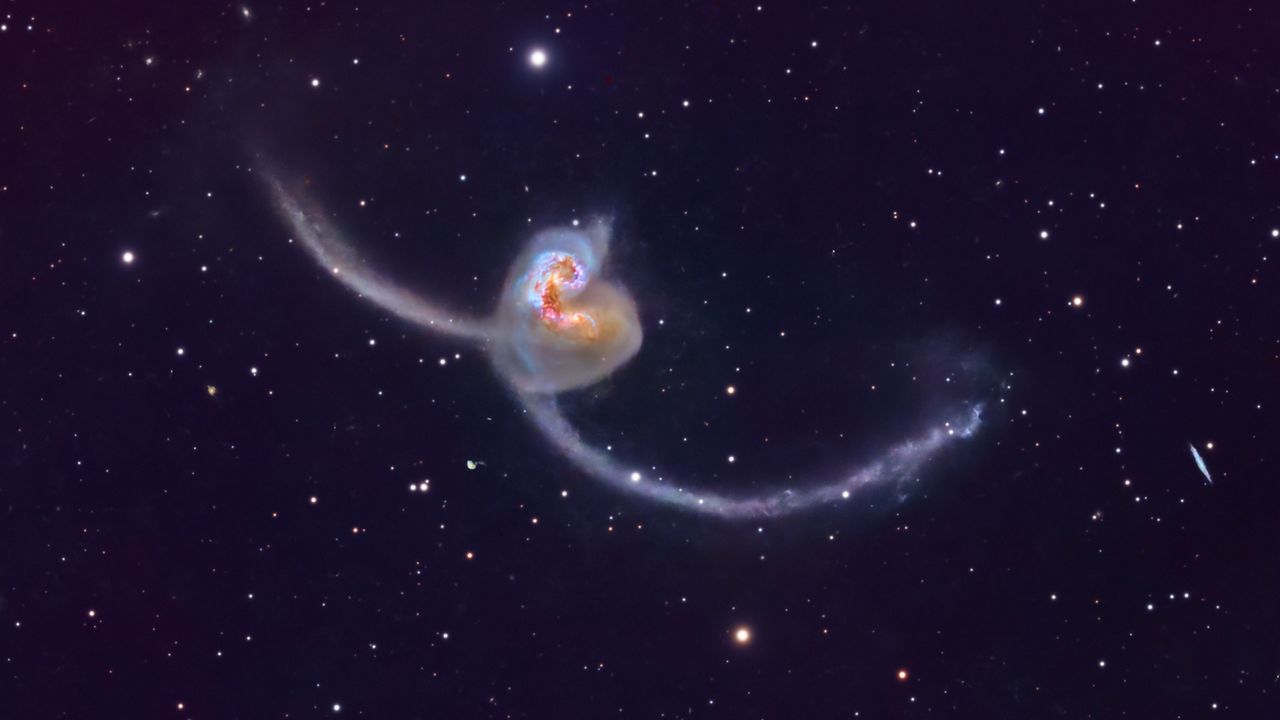
The recent high-fidelity capture of the Antennae Galaxies, designated NGC 4038 and NGC 4039, serves as a poignant reminder of the dynamic and violent nature of our universe. Located approximately 65 million light-years away in the constellation Corvus, these two spiral galaxies are currently locked in a gravitational embrace that has lasted for hundreds of millions of years. This interaction is not merely a visual spectacle; it is a complex laboratory for galactic evolution.
The quality of the image produced by modern astrophotography equipment demonstrates a significant shift in the technological landscape.
Historically, capturing the intricate tidal tails and the vibrant star-forming regions of the Antennae required the intervention of multi-billion-dollar orbital observatories or massive terrestrial arrays. Today, the convergence of high-quantum-efficiency CMOS sensors, precision robotic mounts, and sophisticated post-processing algorithms has empowered independent observers to produce data that rivals professional standards. This democratization of high-resolution imaging is a critical development for the broader space industry, as it decentralizes the ability to monitor and document deep-space phenomena.
The Mechanics of Interstellar Mergers and Tidal Evolution
At the heart of the Antennae Galaxies lies a chaotic interplay of gas, dust, and dark matter. As the two galactic nuclei approach one another, the resulting tidal forces strip away vast streams of stars and interstellar medium, forming the characteristic 'antennae' that stretch across the void. These structures are not static; they are the result of billions of individual stellar trajectories being rewritten by the shifting gravitational barycenter of the merging system. Within the dense clouds of molecular hydrogen compressed by this collision, a 'starburst' phenomenon is occurring.
The rate of star formation in these regions is exponentially higher than in isolated spiral galaxies.
Analyzing these images provides vital insights into the future of our own Milky Way, which is destined for a similar encounter with the Andromeda Galaxy. The capture of distinct clusters within the Antennae—known as Super Star Clusters—allows researchers and enthusiasts alike to observe the birth of entire stellar populations in real-time. From a strategic intelligence perspective, the ability to visualize these processes with such clarity from the ground level underscores the maturation of the global optical supply chain. The precision required to track a target across the celestial sphere for dozens of hours is a testament to the industrial refinement of motion control and optical glass fabrication.
Socio-Economic Implications of High-Fidelity Space Visualization
The impact of such imagery extends far beyond the academic circles of astrophysics. In the current geopolitical and economic climate, space has transitioned from a niche scientific pursuit to a central pillar of national strategy and private investment. High-impact visual data acts as a primary catalyst for public interest, which in turn drives political will and capital allocation for space exploration initiatives. When a single photographer can capture the 'dueling' nature of galaxies with such precision, it humanizes the vast scales of the cosmos and makes the 'Space Economy' a tangible reality for the global populace.
This visual narrative is essential for sustaining the momentum of the current space renaissance.
Furthermore, the proliferation of high-end imaging data contributes to a global 'open-source' archive of the night sky. While professional observatories focus on specific narrow-field research, the global community of advanced astrophotographers provides broad-sky coverage that can occasionally detect transient events, such as supernovae or near-earth objects, before automated systems. This collaborative ecosystem enhances our planetary situational awareness. The industrial context here is clear: the demand for high-performance sensors and optics is no longer limited to government agencies, creating a robust, multi-tier market for aerospace-grade hardware in the private sector.
Strategic Synthesis of Visual Data in the Space Economy
The capture of the Antennae Galaxies is more than an aesthetic achievement; it is a manifestation of the current state of technological parity. We are witnessing a period where the tools of discovery are in the hands of the many, not just the few. This shift necessitates a reevaluation of how we value and utilize astronomical data. The strategic verdict is that high-resolution imagery serves as the frontline of space diplomacy and education. It bridges the gap between complex mathematical models of galactic dynamics and the intuitive understanding required to inspire the next generation of aerospace engineers and scientists.
Visual intelligence is the bridge between the abstract and the actionable.
As we look at the current industrial trajectory, the continued advancement of ground-based imaging will likely complement the next generation of space telescopes. By offloading the documentation of well-known structures to a highly capable global network of observers, professional assets can be reserved for the most challenging frontiers of the early universe. The Antennae Galaxies, in their eternal duel, remain a symbol of the transformative power of gravity and the relentless human desire to see further into the darkness. In the final analysis, our ability to capture the complex beauty of a galactic merger is a direct reflection of our own technological maturity and our strategic readiness to engage with the wider cosmos.