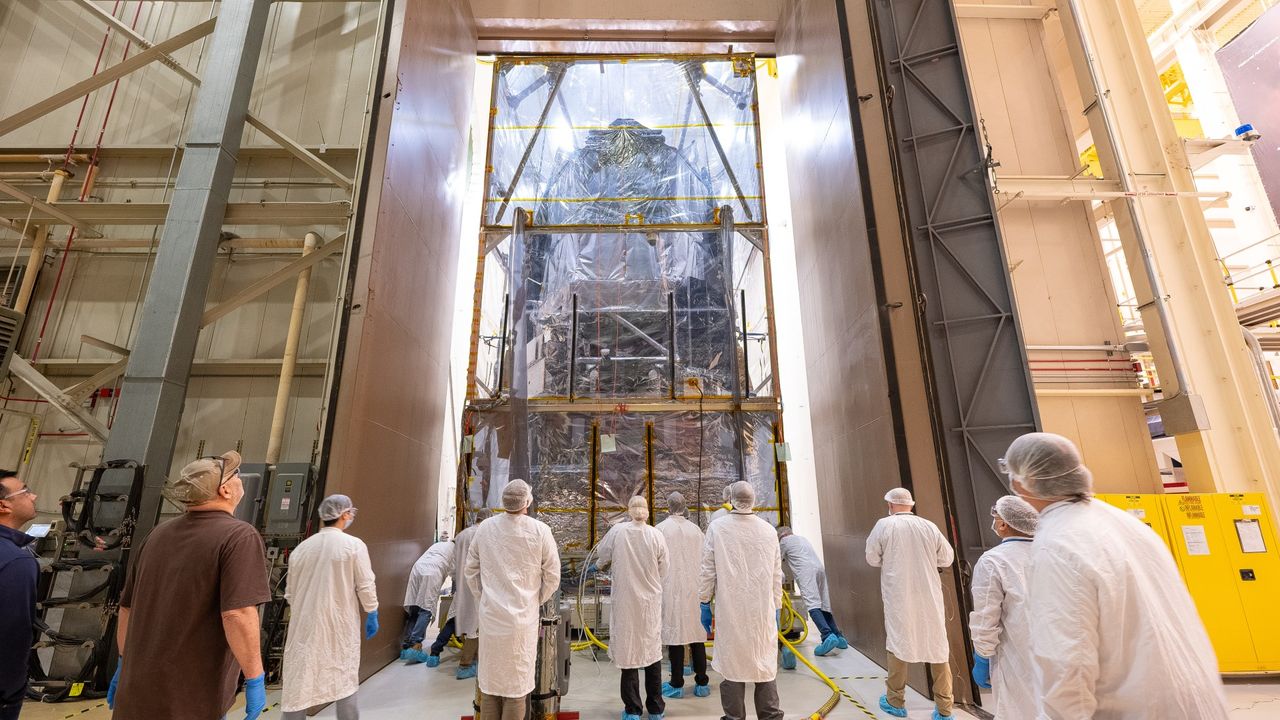
The Kinetic Crucible of Goddard Space Flight Center
As of March 26, 2026, the Nancy Grace Roman Space Telescope has transitioned from a theoretical marvel into a hardened piece of spaceflight hardware. Within the high-bay cleanrooms of NASA’s Goddard Space Flight Center, the observatory is currently undergoing its most physically demanding phase: environmental vibration testing. This process, colloquially referred to as 'rattling' the telescope, is a calculated simulation of the violent acoustic and mechanical stresses it will encounter during its ascent atop a heavy-lift launch vehicle.
This phase is not merely a box-ticking exercise for the engineering teams; it is the final validation of years of structural modeling. The Roman observatory is designed to operate at the second Lagrange point (L2), nearly a million miles from Earth.
Unlike terrestrial observatories, there are no second chances for structural repairs once the fairing separates. The current testing regime subjects the 2.4-meter primary mirror and its sophisticated instrumentation to sine and random vibrations that mimic the roar of rocket engines.
The strategic significance of this 'rattle' cannot be overstated. By successfully navigating these tests, the Roman program proves that its revolutionary Wide Field Instrument (WFI) and the technology-demonstrating Coronagraph can withstand the G-forces of launch without losing their sub-micron alignment. This is the industrial standard for modern deep-space assets: total resilience under extreme kinetic energy.
Engineering a Panoramic Eye for the Dark Universe
The core value proposition of the Roman Space Telescope lies in its unprecedented field of view. While the James Webb Space Telescope (JWST) offers deep-field sensitivity through a 'keyhole' perspective, Roman provides a panoramic lens. Its field of view is approximately 100 times larger than that of the Hubble Space Telescope, yet it maintains the same exquisite resolution. This is achieved through the Wide Field Instrument, a 300-megapixel camera that will map the cosmos at a speed and scale previously thought impossible.
From a strategic intelligence perspective, the Roman telescope represents a shift from 'point-and-stare' astronomy to 'wide-area surveillance' of the universe. The engineering challenge is maintaining the stability of this massive field of view. The vibration tests currently underway are specifically designed to ensure that the delicate optical bench—the skeleton holding the mirrors and sensors—remains rigid.
Any microscopic shift during launch would compromise the mission's ability to measure the subtle distortions of gravitational lensing.
Furthermore, the Roman Coronagraph Instrument is testing the limits of high-contrast imaging. This component is designed to suppress the glare of distant stars to reveal the faint light of orbiting exoplanets. The precision required is akin to spotting a firefly next to a lighthouse from miles away. The structural integrity being validated today is the foundation upon which the next decade of exoplanetary discovery will be built.
The Macro-Economic Impact of the Data Deluge
The industrial context of the Roman Space Telescope extends far beyond astrophysics. The mission is set to produce a staggering amount of data—estimated at over 20 petabytes over its primary mission life. This 'data deluge' is already catalyzing advancements in automated processing and machine learning within the aerospace sector. Companies involved in high-speed space communications and cloud-based data storage are closely monitoring Roman’s progress as a benchmark for future large-scale satellite constellations.
The supply chain involved in the Roman mission—ranging from primary contractors like Ball Aerospace and Teledyne to specialized component manufacturers—demonstrates the maturity of the U.S. space industrial base. The successful 'rattling' of the telescope validates the manufacturing processes of these entities.
It signals to the global market that the infrastructure for high-cadence, high-resolution space observation is not only viable but ready for deployment.
Moreover, the mission’s focus on Dark Energy and Dark Matter addresses fundamental questions that have long-term implications for our understanding of physics. However, in the immediate term, the strategic value lies in the technological spin-offs. The sensors developed for Roman have direct applications in Earth observation, telecommunications, and national security, reinforcing the dual-use nature of high-end space exploration technology.
The Strategic Verdict on Orbital Dominance
The Roman Space Telescope is the definitive answer to the requirement for rapid, large-scale cosmic mapping. As it survives the rigors of environmental testing in early 2026, it cements its position as the cornerstone of the next generation of space-based assets. This mission is not an isolated scientific endeavor; it is a critical component of a broader strategy to maintain technological superiority in the space domain.
The ability to build, test, and launch an instrument of this complexity is a clear demonstration of industrial and sovereign capability.
The 'rattling' we witness today is the sound of a new era in discovery. By the time Roman reaches L2, it will have been forged in the most intense conditions Earth can simulate. This ensures that its mission to survey billions of galaxies and thousands of exoplanets will proceed with minimal risk of mechanical failure. The transition from the focused gaze of Webb to the wide-area surveillance of Roman marks a paradigm shift in how humanity monitors the celestial environment.
In conclusion, the Roman Space Telescope is more than a successor to Hubble; it is a force multiplier for astronomical data. Its successful validation in 2026 is a testament to the resilience of the space industrial complex. As we look toward the launch, the focus remains on the flawless execution of these final stress tests. The strategic verdict is clear: Roman is ready to redefine the boundaries of the observable universe, ensuring that the vast expanse of space is no longer a collection of isolated points, but a fully mapped and understood frontier.