The Persistent Gaze of Orbital Infrastructure
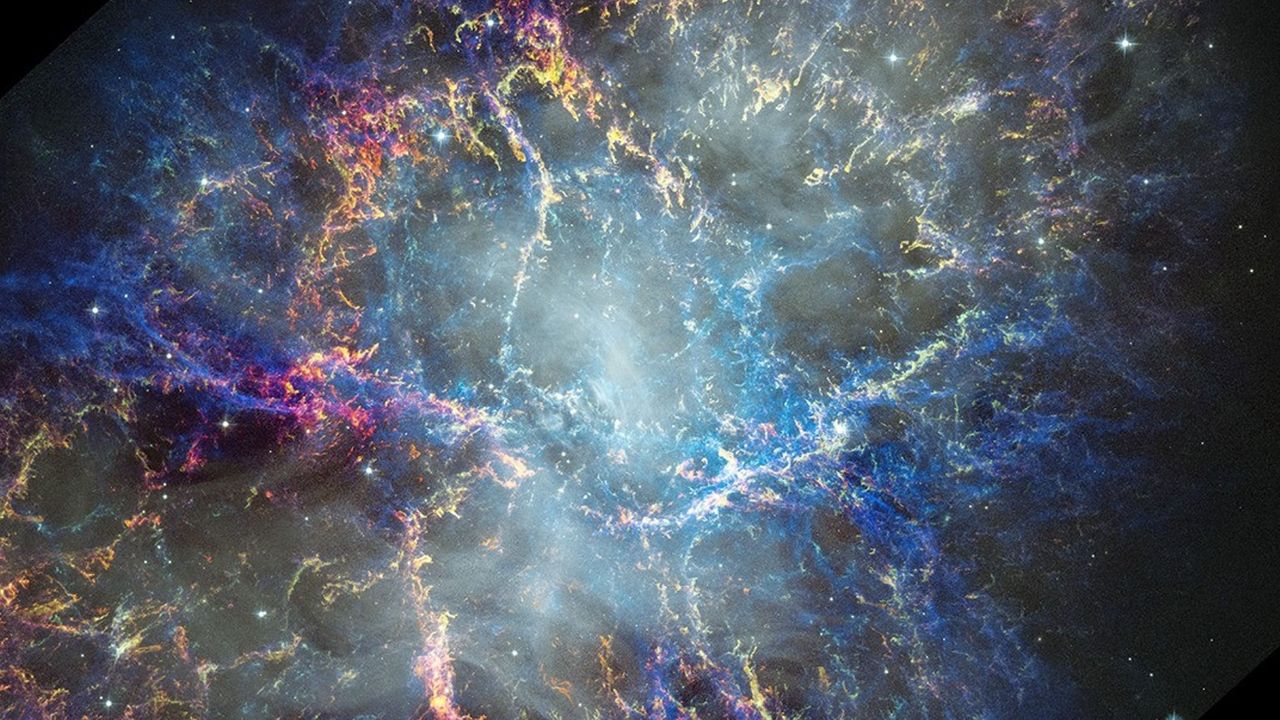
The release of the Hubble Space Telescope’s latest imagery of the Crab Nebula (M1) on March 23, 2026, represents more than a mere aesthetic achievement. It marks a rigorous technical milestone in the field of longitudinal astrophysics. By revisiting this iconic supernova remnant exactly twenty-five years after its primary high-resolution survey at the turn of the millennium, NASA and the ESA are leveraging a unique temporal baseline.
This observation serves as a testament to the enduring operational viability of the Hubble platform, which continues to provide indispensable data despite the presence of more modern orbital assets.
The Crab Nebula, the remains of a supernova observed by astronomers in 1054 AD, has long been a primary target for calibrating complex space-based sensors. However, the 2026 revisit is specifically designed to measure the minute physical changes in the nebula’s structure that have occurred over a quarter-century. This is a rare opportunity to witness stellar evolution in human real-time, providing a high-fidelity dataset that bridges the gap between historical observations and modern high-energy physics.
Deciphering the Kinetic Evolution of M1
At the heart of this deep-dive analysis is the comparison between the 2000-era datasets and the current 2026 observations. The focus is on the expansion rate of the ionized gas filaments and the shifting dynamics of the pulsar wind nebula. Hubble’s Wide Field Camera 3 (WFC3) has captured the intricate, glowing tendrils of oxygen, sulfur, and hydrogen with a precision that allows for the mapping of shockwave propagation across the nebula’s six-light-year span.
These movements, while subtle, reveal the immense kinetic energy still being pumped into the environment by the central pulsar.
Strategic intelligence suggests that the velocity of these filaments is not uniform, indicating complex interactions with the surrounding interstellar medium. By tracking these changes over 25 years, researchers can refine models of how heavy elements—the building blocks of terrestrial planets—are dispersed into the galaxy. The resolution provided by Hubble in 2026 confirms that the magnetic field structures within the nebula are far more turbulent than previously modeled, challenging existing assumptions regarding the cooling rates of supernova remnants and the stability of neutron star environments.
Synergistic Calibration and the Data Legacy
The industrial significance of this revisit extends to the calibration of the broader Great Observatories network. The 2026 Hubble data provides a crucial optical-wavelength baseline that complements the infrared capabilities of the James Webb Space Telescope (JWST) and the high-energy X-ray data from the Chandra Observatory. This multi-spectral synergy is essential for constructing a comprehensive 4D model of the nebula’s expansion.
In the current competitive landscape of space exploration, the ability to cross-reference data across decades and platforms is a strategic advantage for Western space agencies.
Furthermore, the archival value of this data cannot be overstated. As private sector entities and emerging space nations increase their presence in low Earth orbit, the long-term datasets held by established agencies serve as a proprietary gold standard for scientific accuracy. The 2026 Crab Nebula survey reinforces the necessity of maintaining legacy systems that can provide consistent, reliable metrics over decades. This continuity is vital for the development of future mission parameters for the Nancy Grace Roman Space Telescope, ensuring that upcoming surveys are built upon a foundation of proven, high-resolution temporal data.
Strategic Longevity in High-Frontier Research
The ultimate verdict on the March 23 release is one of institutional and technical resilience. Hubble’s ability to perform high-level science in 2026, decades past its original decommissioning date, underscores a shift in how orbital assets are managed. The focus has moved from rapid replacement to the strategic optimization of existing hardware through software enhancements and precision maneuvering. This revisit to the Crab Nebula proves that 'legacy' does not mean 'obsolete'; rather, it represents a deep, irreplaceable intelligence asset that provides the context necessary for all new discoveries.
As we analyze the macro-impact of this mission, it becomes clear that the value of space-based observation lies in its duration. The 25-year interval between major surveys of M1 allows for a level of scientific certainty that cannot be replicated by short-term missions. The 2026 data confirms the Crab Nebula as a dynamic, rapidly changing environment, serving as a reminder that the universe is in a constant state of flux. For the global scientific community, this release is a call to prioritize long-term infrastructure and data integrity, ensuring that our understanding of the cosmos is built on a legacy of persistent, high-fidelity observation.